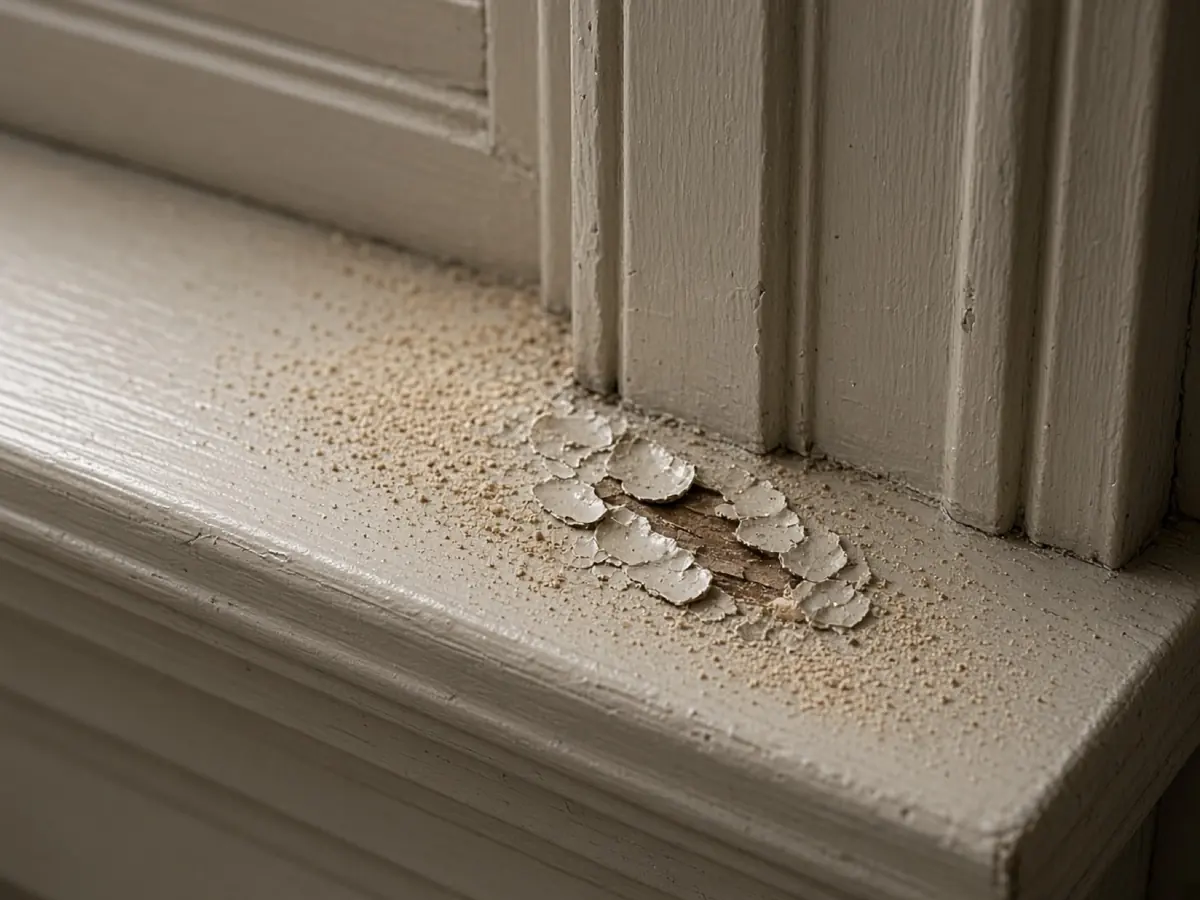
What people notice first
The usual clues are wings on a windowsill, a mud-colored tube on a foundation, or wood that sounds hollow or breaks across the grain. Each clue has other explanations.
Ant swarmers also shed wings. Mud can be rain splash. Soft wood can be a leak. The inspection is how those possibilities are separated.
If you only have a stain on a ceiling, say that. Booking a termite treatment from a stain alone is how people pay for the wrong work.
How the inspection differs from general pest control
A general pest visit spends its time on trails, droppings, moisture in cabinets, and gaps at doors.
A termite inspection spends its time on wood-to-soil contact, foundation joints, crawl spaces or slabs, sill plates if they can be seen, and any tubes or damaged members.
Access matters. A locked crawl space, stored items against the foundation, and finished basements that hide the sill all limit what can be concluded.
The written result should say what was seen and what could not be seen.
Species groups matter because the response category changes. Subterranean termites keep a connection with soil moisture and may build shelter tubes. Drywood termites can live inside wood with less dependence on the soil.
This page does not claim which group is present at a Lancaster, PA address, because that is an inspection finding, not a regional slogan.
A specimen or clear tube evidence is how that finding is made. A blurred photo of wings is a reason to look, not a finished identification.
Treatment categories, without a recipe
When evidence supports active termites, the conversation is about categories: a soil-related treatment where that fits, a wood treatment where that fits, bait or monitoring stations where they fit the construction, and repairs that a pest company may not perform.
This page does not give mixing rates, trench depths, or foam recipes. Those belong on a product label and with a qualified applicator. Structural fumigation is not offered here.
If someone describes fumigation as the only option, that is a different service with its own rules, and it is not sold here.
Damage repair is separate from killing or monitoring insects. Replacing a sill, a joist, or a section of trim may be necessary and may be a carpenter's job.
Killing insects does not restore strength to wood they already hollowed. A clear quote says which of those outcomes is included.
Writing down where termites were seen near Manheim Township, including the eave gap, makes the Lancaster visit shorter and more exact.
A picture of pellets, wings, or a hole can be useful if the scale is clear.
It still cannot show whether the activity is current, whether the colony is the one in the photo or another area of the house, or whether the wood is structurally compromised.
Do not scrape tubes off and call the problem finished. Removing the tube removes the clue and does not remove insects in the soil or the wood.
Preparation and safety
You may be asked to move storage away from foundation walls, provide crawl access, and keep people and pets away from areas being treated according to the label of the product actually used.
There is no single re-entry interval on this page. Gardens, wells, and ponds near a foundation are details to mention before any soil-related work is discussed, because labels restrict applications near water.
Tell the company about them. Do not assume a treatment is harmless because it happens outside.
General household pests are on the homepage.
Termites in Lancaster: local conditions
Eastern subterranean termites live in the soil of Lancaster County and can reach wood through gaps in stone and block foundations.
The city has brick rowhomes and older stone buildings around downtown, mid-century homes in the surrounding townships, and farmhouses and outbuildings across the county, many with stone foundations and basements.
Do not close up the expansion joint before the inspection for termites in Lancaster, or the useful evidence is gone.
Where termites show up near Lititz
Where termites show up near downtown Lancaster
For termites in Lancaster, the visit starts at the weep holes and then follows whatever that shows.
The time of year in Lancaster changes the pressure, and termites near Manheim are still confirmed at the window well.
Termites signs in Lancaster
The termites check in Lancaster covers the dishwasher line and the expansion joint on the same walk-through.
Termites near downtown Lancaster
What decides the termites plan in Lancaster is the building near East Hempfield, and the irrigation valve is on that list.
Termites signs in Lancaster
Usually yes. The report shows evidence of activity and damage and is often requested in a sale. Say when you need it and whether a written report is required.
Termites near Millersville
Homes around Manheim get the termites inspection at the bath trap first, because that is where the activity usually starts.
Where termites show up near Strasburg
Writing down where termites were seen near Strasburg, including the eave gap, makes the Lancaster visit shorter and more exact.
Where termites show up near Manheim Township
Do not close up the stored firewood before the inspection for termites in Lancaster, or the useful evidence is gone.
Do not close up the expansion joint before the inspection for termites in Lancaster, or the useful evidence is gone.
Where termites show up near Strasburg
Eastern subterranean termites live in the soil of Lancaster County and can reach wood through gaps in stone and block foundations.
What decides the termites plan in Lancaster is the building near the Southern Market area, and the irrigation valve is on that list.
Coverage for termite control in Lancaster is confirmed from the street, including places such as Lancaster Township. The details are on the Rodent Control Areas serving Lancaster, PA page.